


How Gurgaon Hotels Can Attract More Business Travellers
- 24 hours ago
- 9 min read
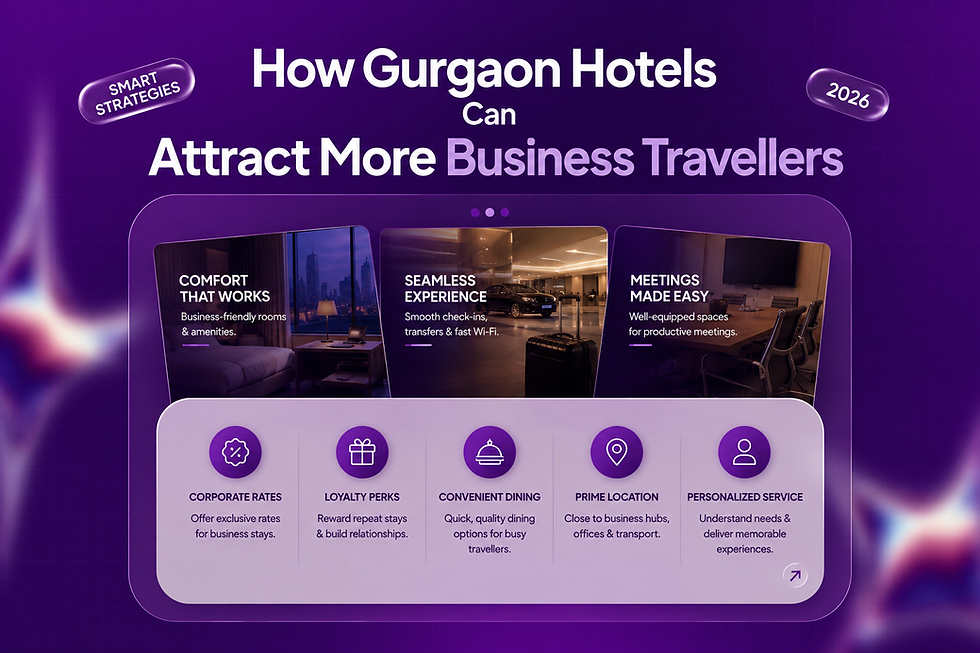
Gurgaon is one of India’s strongest business travel markets, but many hotels still sell rooms as if every guest is the same. A weekday corporate traveller booking for one night has very different needs from a family booking a weekend stay. The hotel that understands this wins repeat business, not just one-off bookings.
The opportunity is clear. Gurgaon has large corporate parks, business districts, multinational offices, start-up clusters, co-working hubs, healthcare facilities, embassies nearby in Delhi, and strong airport access. Corporate travel flows through areas such as Cyber City, Golf Course Road, Udyog Vihar, Sohna Road, MG Road, and Sector 44. Business travellers come for client meetings, training sessions, audits, conferences, project work, interviews, and short-term assignments.
For hotels, this means weekday occupancy can become more stable. It also means less dependence on last-minute OTA discounting. The goal is not only to attract more business guests, but to become the hotel those guests and their travel teams prefer to book again.
Gurgaon has the right demand, but hotels need sharper positioning
Business travel demand in Gurgaon is not one single market. A senior executive visiting Cyber City may value speed, privacy, and premium service. A sales team travelling every month may care more about predictable pricing, breakfast, early check-in, and easy invoicing. A long-stay consultant may need laundry, a quiet work area, and a kitchenette or meal plan.
A hotel that tries to appeal to all of them with the same message often sounds generic. Strong corporate positioning starts with choosing the right guest segments.
Identify the corporate profiles that fit your hotel
Start by mapping demand around your property. Keep the exercise practical. Look at a 3 km to 7 km radius and list the companies, office parks, hospitals, universities, training centres, and event venues nearby.
Then group likely bookers into profiles such as:
Frequent individual travellers
Sales managers, consultants, auditors, trainers, and project leads who visit Gurgaon often.
Executive travellers
Senior leaders who expect faster service, premium rooms, airport transfers, privacy, and smooth billing.
Team bookings
Small groups travelling for training, onboarding, events, or client delivery.
Long-stay business guests
Consultants, relocation guests, expats, contract workers, or employees on project assignments.
Meeting-led guests
Companies that need rooms with small meeting spaces, meal packages, and transport coordination.
For each profile, note three things:
Who books the room
Who stays in the room
What problem the hotel must solve
Those three answers are not always the same. An employee may stay, an admin manager may book, and the finance team may approve the bill. Your offer has to satisfy all three.
Match your location to business needs
Location messaging should be specific. “Near corporate offices” is weak. “Smooth access to Cyber City, Udyog Vihar, and Golf Course Road” is stronger if true. Mention realistic travel convenience without promising exact travel times that can change with traffic.
Useful location details can include:
Distance from Indira Gandhi International Airport
Access to Rapid Metro or major roads
Nearby business parks and corporate clusters
Proximity to event venues, hospitals, or training centres
Easy pick-up and drop-off points
Corporate guests do not want surprises. Clear local information builds trust before they book.
Business travellers choose hotels that make work easier
A business traveller may tolerate a smaller room, but rarely tolerates poor Wi-Fi, slow invoicing, noisy corridors, or unreliable transport. Corporate-ready hotels win because they reduce friction.
Prioritise the amenities that affect productivity
The basics matter more than decorative extras. If the essentials are weak, no amount of promotional copy will fix the guest experience.
A corporate-ready room should include:
High-speed Wi-Fi that works across the property
Test it in rooms, corridors, meeting spaces, and restaurants. Promote it only if it is reliable during peak usage.
Comfortable work areas
A proper chair, good lighting, enough plug points, and a table suitable for laptop work make a real difference.
Quiet rooms
Business travellers often prepare for meetings or take calls from the room. Noise control should be part of room allocation.
Fast breakfast service
Many guests leave early. Offer early breakfast, packed breakfast, or quick service for repeat corporate guests.
Laundry and pressing
Same-day pressing is valuable for travellers attending meetings.
Smooth billing
GST invoices, company details, split billing, and fast checkout can decide whether travel admins keep booking your hotel.
Meeting support
Even a small boardroom, printer access, tea and coffee service, and stable internet can win group bookings.
Build transport into the offer
Transport is a major concern in Gurgaon because travel time can vary sharply by route and hour. Hotels that help guests manage this feel more dependable.
Consider offering:
Airport pick-up and drop packages
Office drop services within selected nearby zones
Tie-ups with reliable cab operators
Clear travel guidance for peak-hour movement
Wake-up call plus cab readiness for early flights
Dedicated support for group arrivals
This does not mean every booking needs free transport. It means transport should be easy to request, fairly priced, and dependable.
Train staff for corporate expectations
Corporate guests value speed and consistency. They may not complain loudly, but they will avoid returning if small issues keep repeating.
Train teams to handle:
Early check-in requests
Late arrivals
GST billing queries
Corporate card payments
Invoice corrections
Airport transfer coordination
Last-minute room extensions
Quiet room requests
Fast checkout
A useful test is simple. Can a regular corporate guest check in, get online, eat, sleep, receive a correct invoice, and leave without making repeated calls? If yes, the hotel is on the right track.
Corporate pricing should beat OTA dependence without harming revenue
Many Gurgaon hotels rely heavily on OTAs for visibility. OTAs can help fill rooms, but they may not be the best path for repeat corporate demand. Business travellers and travel teams often prefer direct corporate rates when the value is clear.
The aim is not to offer the cheapest price. The aim is to offer better total value, better terms, and easier booking.
Corporate booking need | What the hotel can offer |
Predictable weekday pricing | Fixed corporate rates for defined room categories |
Faster approval | Rate sheet with inclusions and GST clarity |
Fewer booking errors | Direct contact for reservations or a simple booking form |
Better value than OTA | Breakfast, Wi-Fi, early check-in subject to availability, and invoice support |
Higher repeat bookings | Monthly billing, credit terms after approval, and loyalty benefits |
Create rate plans by corporate value
Avoid giving one flat discount to every company. Build rate bands based on potential volume and booking pattern.
For example:
Starter corporate rate
For companies with occasional bookings. Include breakfast, Wi-Fi, and GST invoice support.
Preferred corporate rate
For companies with regular monthly room nights. Add priority room allocation, flexible cancellation windows, and transport add-ons.
Key account rate
For high-volume clients. Add negotiated credit terms, monthly reporting, meeting room benefits, and a named account contact.
Long-stay business rate
For stays of 7 nights, 15 nights, or 30 nights. Include laundry bundles, meal plans, and room upgrade options where possible.
Review these rates every quarter. If demand is strong during certain weekdays, protect your average daily rate. If occupancy drops during specific periods, promote corporate packages instead of blanket OTA discounts.
Make direct booking easier than OTA booking
Corporate guests will not book direct if the process is slow. A hotel website that only shows a phone number may lose busy bookers. Make direct booking simple.
Practical improvements include:
A “Corporate Enquiry” button on the website
A short form asking company name, dates, room count, billing needs, and transport needs
A response time target, such as within one working hour during the day
A downloadable corporate rate card for approved partners
WhatsApp support for repeat bookers
Clear mention of GST invoice availability
A dedicated email for corporate bookings
Direct corporate sales grow when booking feels safe, quick, and professional.
Partnerships and marketing should reach people who actually control travel
Hotels often advertise to travellers but ignore the people who decide where travellers stay. Corporate demand may come through admin teams, HR teams, finance teams, executive assistants, procurement teams, travel desks, and corporate travel management companies.
A strong plan reaches both the guest and the booker.
Work with corporate travel management companies
Corporate travel management companies, often called TMCs, already manage hotel bookings for business clients. Partnering with them can increase visibility among companies that use approved hotel lists.
To prepare for TMC outreach, keep these ready:
Corporate rate sheet
Room category details
GST and billing process
Cancellation terms
Blackout dates, if any
Safety and security details
Nearby corporate locations
Meeting room and event details
Photos of rooms, bathrooms, restaurant, and common areas
Contact person for reservations and escalations
TMCs value reliability. If a hotel confirms bookings quickly, honours rates, and handles billing cleanly, it becomes easier to recommend.
Use Google Ads for high-intent searches
Google Ads can capture people already looking for business hotels in Gurgaon. Focus on search intent, not broad travel terms.
Useful keyword themes include:
business hotel in Gurgaon
corporate hotel near Cyber City
hotel near Udyog Vihar for business stay
hotel near Golf Course Road Gurgaon
corporate stay near MG Road Gurgaon
hotel with meeting room in Gurgaon
long stay hotel in Gurgaon for business
Send the traffic to a dedicated corporate landing page. Do not send paid clicks to a generic home page. The landing page should show corporate benefits, location advantages, room types, transport support, meeting options, and an enquiry form.
Use LinkedIn Ads for business audiences
LinkedIn can help reach admin managers, HR leaders, office managers, procurement teams, and business travellers in relevant industries. It may cost more than search ads, so keep the campaigns narrow.
Test audiences by:
Job function
Seniority
Company size
Industry
Location
Companies with offices in Gurgaon or Delhi NCR
Promote clear offers such as weekday corporate rates, long-stay packages, meeting room bundles, or new corporate account onboarding. Keep the message practical. Business bookers respond to clarity, not vague luxury claims.
Build content around business travel needs
Content marketing works when it answers real travel questions. For Gurgaon hotels, useful content can help both travellers and travel planners.
Strong content topics include:
Best areas to stay in Gurgaon for business travel
A guide to reaching Cyber City, Udyog Vihar, and Golf Course Road
What to check before booking a corporate hotel in Gurgaon
How to plan a one-day business trip to Gurgaon
Hotel checklist for admin teams booking employee travel
Long-stay business travel tips for Gurgaon
Meeting room planning guide for small corporate groups
This content can support SEO, paid campaigns, sales outreach, and email follow-ups. It also shows that the hotel understands the local corporate market.
Retention, reviews, and measurement turn one booking into repeat revenue
Winning a corporate guest once is useful. Winning the company’s repeat travel is far more valuable. That requires a system for satisfaction, follow-up, and tracking.
Ask for the right reviews from corporate guests
Reviews influence business travellers, especially when they mention work-related needs. A review that says “good Wi-Fi, clean room, fast checkout, and proper invoice” can be more persuasive than a generic five-star comment.
Ask satisfied corporate guests for reviews after checkout. Keep the request short and polite. If they booked through a company travel desk, ask the booker for internal feedback as well.
Track review themes such as:
Wi-Fi quality
Cleanliness
Sleep quality
Breakfast speed
Staff response
Billing accuracy
Transport support
Location convenience
Meeting room experience
Negative feedback should lead to visible fixes. If several guests mention slow invoices, improve the invoicing process. If transport complaints repeat, review the vendor. Reputation management is not only about replies, it is about repair.
Build loyalty benefits for repeat corporate stays
A corporate loyalty programme does not need to be complicated. It should reward repeat behaviour and make the guest feel recognised.
Possible benefits include:
Room preference saved for repeat guests
Priority early check-in, subject to availability
Complimentary room upgrade after a set number of stays
Laundry credits for long-stay guests
Meal credits for frequent travellers
Airport transfer discounts
Meeting room credits for companies crossing room-night targets
Dedicated reservation support for approved corporate accounts
For companies, offer account-level benefits. For travellers, offer stay-level benefits. Both matter.
Use seasonal B2B promotions to protect occupancy
Gurgaon demand can rise and fall with corporate calendars, festive periods, financial year cycles, training schedules, and event seasons. Plan promotions before weak periods arrive.
Useful seasonal offers include:
Weekday business stay packages during low-demand weeks
Training group packages with rooms, meals, and meeting space
Long-stay packages for project teams
Year-end corporate retreat or offsite packages
New financial year corporate rate renewals
Monsoon stay and meeting bundles
Weekend corporate extension rates for guests staying after meetings
Avoid deep public discounts that train every guest to wait for cheaper rates. Use targeted B2B offers for approved companies, TMCs, and repeat bookers.
Track corporate booking growth over time
If corporate sales are not measured, they become guesswork. Track a simple set of numbers each month.
Key metrics include:
Corporate room nights
Corporate revenue
Average daily rate for corporate bookings
Direct corporate bookings versus OTA bookings
Number of active corporate accounts
Repeat booking rate by company
Enquiry-to-booking conversion rate
Revenue by source, such as direct, TMC, Google Ads, LinkedIn, referral, or OTA
Cancellation rate by account
Review scores from corporate guests
Create a simple dashboard in a spreadsheet if you do not have hotel revenue software. Review it every month. Look for patterns. Which companies book repeatedly? Which ads bring serious enquiries? Which rate plans protect profit? Which months need early promotions?
The best corporate strategy improves through small, steady decisions.
Make business travel a defined sales channel, not a side activity
Gurgaon hotels have a strong chance to win more business travellers because the demand already exists nearby. The difference comes from how clearly the hotel serves that demand.
Start with the basics. Define the corporate profiles that fit the property. Build offers around work needs, not only room discounts. Make direct booking simple. Price corporate accounts with care. Build relationships with travel managers and TMCs. Use Google Ads and LinkedIn Ads to reach serious bookers. Publish content that helps business travellers understand Gurgaon. Ask for reviews that reflect corporate satisfaction. Reward repeat stays. Track the numbers every month.
A hotel that treats corporate travel as a proper sales channel gains more than occupancy. It earns predictable revenue, repeat relationships, and a stronger position in one of India’s most active business markets.


Comments