

Why Your Hotel Is Losing Direct Bookings to OTAs
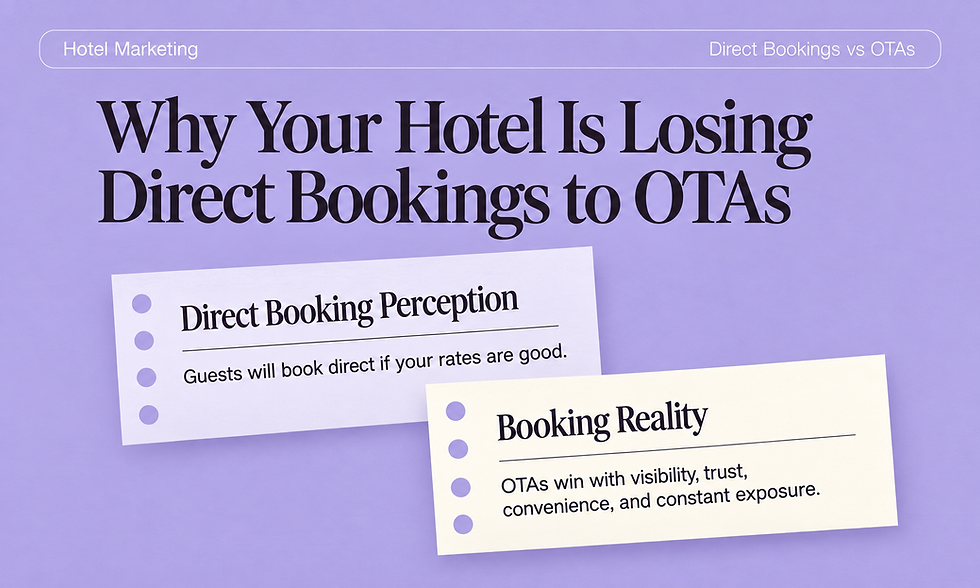
A traveller finds your hotel on Google, checks your photos, reads a few reviews, visits your website, and then books on an OTA. The stay is yours, but the booking is not.
This is one of the most common revenue leaks in hospitality. Hotels spend on visibility, service, content, and guest experience, yet online travel agencies often capture the final reservation. If your hotel is losing direct bookings, the issue is rarely just commission. It is usually a mix of trust, convenience, pricing perception, website friction, and weak follow-up.
The good news is that OTAs are not unbeatable. They are simply very good at removing doubt from the booking journey. A hotel can do the same with the right direct booking strategy.
Why travellers choose OTAs even after finding your hotel first
Many hoteliers assume guests book through OTAs because they discovered the property there. That is often true, but not always. A traveller may discover the hotel through brand search, Google Maps, Instagram, a referral, or a local listing, then still go back to Booking.com, Agoda, Expedia, MakeMyTrip, or another OTA to complete the booking.
This happens for practical reasons.
OTAs make comparison feel easier
Travellers like certainty. OTAs offer quick rate comparison across multiple hotels, room types, cancellation policies, guest ratings, and locations. Even if a guest likes your property, they may want to confirm they are making a safe choice.
A hotel website usually asks the guest to focus on one property. An OTA lets them compare ten options in minutes. That comparison experience creates confidence.
OTAs often feel more familiar
Guests may already have an OTA account, saved card details, loyalty credits, app discounts, or wallet offers. They may also trust the OTA’s cancellation process more than a hotel’s individual policy.
This is not always fair to the hotel, but it shapes behaviour. Familiarity reduces friction.
OTAs invest heavily in trust signals
OTAs place reviews, ratings, “last booked” prompts, map views, policies, filters, and scarcity messages around the booking flow. The traveller sees proof at every step.
If your hotel website has limited reviews, unclear policies, slow pages, or a dated booking engine, the OTA looks safer, even if the price is similar.
OTAs win when the hotel website creates doubt
Small issues create hesitation:
The room photos do not match the OTA listing.
The cancellation policy is hard to find.
The direct rate is not clearly better.
The booking engine opens in a new page that looks unrelated.
The website speed is poor on mobile.
Payment options feel limited.
The Google Business Profile has outdated information.
Guests do not always complain about these things. They simply leave and book elsewhere.
The real cost of hotel OTA dependency
OTAs are useful. They bring reach, fill rooms during low-demand periods, and improve OTA visibility in markets where a hotel has limited brand awareness. The problem starts when a hotel becomes too dependent on them.
High hotel OTA dependency affects more than commission.
It weakens guest ownership. The OTA controls much of the pre-arrival communication, remarketing, and future booking relationship. The hotel may serve the guest well, but the OTA often owns the next booking opportunity.
It also trains travellers to search for your hotel elsewhere. If guests regularly see better presentation, smoother booking, or stronger offers on OTAs, direct booking becomes a weaker habit.
There is also a pricing issue. Even when rates are technically the same, OTAs may display coupons, bank offers, member rates, or app-only deals. Guests may perceive the OTA as cheaper, even when the hotel could provide better direct booking benefits.
A healthy channel mix matters. OTAs should support demand, not control it.
OTA bookings can help with reach
OTAs expose the hotel to new audiences
OTAs support low-season occupancy
OTAs offer broad rate comparison
OTAs are useful for first-time discovery
Direct bookings help with profitability and guest ownership
Direct channels reduce commission costs
Hotels can build guest relationships
Hotels can present full brand value
Direct booking supports repeat stays
What your hotel website must do better than an OTA
A direct booking does not happen because a guest likes the hotel. It happens because the guest trusts the hotel enough to book without returning to a third-party platform.
Your hotel website needs to answer every booking question quickly.
Show a clear reason to book direct
“Book direct” is not a benefit by itself. The guest needs to know what they get.
Direct booking benefits can include:
Better room selection
Free breakfast
Flexible cancellation
Early check-in, subject to availability
Late check-out, subject to availability
Welcome drink
Free upgrade priority
No hidden booking charges
Direct support from the hotel team
Keep the offer simple. If the benefit needs a long explanation, it may not work well on the booking page.
Make the booking engine feel safe and simple
Your booking engine should look like part of your hotel website, not a random third-party window. It should load fast, work smoothly on mobile, and show prices, taxes, inclusions, and policies clearly.
A good booking engine reduces effort. A poor one sends guests back to an OTA.
Check these basics:
Is the booking button visible on every key page?
Can guests check availability in a few seconds?
Are room names consistent across your website and OTAs?
Are taxes and fees clear before payment?
Does the payment page look secure?
Is the cancellation policy easy to understand?
If the booking process creates confusion, the OTA wins the final click.
Improve website speed on mobile
Many hotel searches happen on mobile, especially for weekend breaks, business travel, and last-minute stays. Slow pages damage trust before the guest even sees the rooms.
Large images, too many scripts, heavy sliders, and poorly built pages can hurt website speed. A clean, fast hotel website gives guests the feeling that the property is well managed.
Speed is also connected to hotel SEO. Search engines prefer pages that offer a better user experience. Faster pages can help more travellers find and use your direct channel.
Use reviews where guests need reassurance
Reviews should not sit only on a separate page. Add selected guest feedback near room details, the booking section, and important decision points.
Travellers look for proof that the property is clean, safe, well located, and professionally managed. If your website does not show that proof, guests may return to an OTA to read reviews there.
Use real, current reviews. Avoid over-polished claims. Specific guest feedback feels more believable than generic praise.
Fix the gaps between Google, OTAs, and your direct channel
The direct booking journey often starts before a guest reaches your website. It may begin with a Google search, Google Maps result, or brand search after seeing your hotel on an OTA.
That means your online presence must feel consistent.
Keep your Google Business Profile accurate
Your Google Business Profile is often the first place travellers check after hearing about your hotel. It should have updated photos, correct contact details, amenities, check-in information, website link, and active review responses.
If the profile looks inactive, guests may question the hotel’s reliability. If the website link is hard to find or points to a weak page, the OTA becomes the easier option.
A strong Google Business Profile supports direct bookings because it catches high-intent travellers at the moment they are ready to compare or book.
Protect brand search traffic
When someone searches your hotel name, they already have intent. Losing that user to an OTA hurts because the traveller was close to booking direct.
This can happen when OTAs dominate paid ads, organic results, or map visibility for your brand search. Hotels should monitor how their name appears on Google and make sure the official website is easy to identify.
The direct website title, meta description, Google listing, and booking page should reassure guests that they are on the official channel.
Keep rates and content consistent
Rate parity rules vary by market and agreement, but the principle is simple. Guests should not feel punished for booking direct.
If the OTA shows better photos, clearer policies, or a more attractive package, direct booking becomes harder. Your own website should have the best room descriptions, the most complete amenity details, and the clearest value.
A rate comparison widget can help if it is accurate and easy to read. It can show guests that booking direct is equal or better without forcing them to check five websites.
Build a direct booking strategy that works beyond the first visit
Not every traveller books on the first visit. Some compare, discuss, wait for approval, or return later. This is where remarketing and follow-up matter.
Remarketing can bring previous website visitors back with relevant messages. For example, a guest who viewed family rooms can see an offer for school holiday stays. A business traveller who viewed weekday availability can see a direct booking message with flexible check-in or invoice support.
The aim is not to chase every visitor. The aim is to remind high-intent travellers why booking direct is better.
Email also helps when used well. Past guests are more likely to book direct if they remember a good stay and receive a clear reason to return. Promote seasonal packages, repeat guest benefits, and member-only offers without overwhelming them.
A practical direct booking strategy should include:
A fast, mobile-friendly hotel website
A smooth booking engine
Clear direct booking benefits
Strong reviews in the booking journey
Active Google Business Profile management
Brand search protection
Hotel SEO for location and experience-based searches
Remarketing for high-intent visitors
Rate and content checks across OTAs
Regular reporting by channel and campaign
This is also where expert support helps. Mudras Hospitality works with hotels that want to reduce waste, improve direct revenue, and build stronger visibility across search and booking channels.
How to know if OTAs are taking bookings you should have won direct
Look for patterns in your data. You do not need a complex system to start. Even basic checks can reveal where direct bookings are leaking.
Review these signals:
High website traffic but low booking engine conversions
Many brand searches, but OTA bookings still dominate
Strong Google Maps views, but weak direct reservations
High mobile traffic with poor mobile conversion
Guests saying they found you on Google but booked through an OTA
OTA bookings for repeat guests
Direct rates that look less attractive than OTA offers
High exit rates on room or booking pages
Also ask front desk and reservation teams what guests mention. They often hear the real reasons: “The OTA showed free cancellation”, “I had a coupon”, “Your website was not loading”, or “I could not find the room I wanted.”
These comments are valuable. They show where the direct path broke.
Fixing direct bookings is not about leaving OTAs
The goal is not to remove OTAs from your channel mix. For many hotels, that would be unrealistic and risky. The goal is to stop giving away bookings that your hotel could have captured directly.
OTAs should help with reach. Your direct channel should win guests who already know your name, trust your property, or are ready to book.
That requires a better experience across search, website, booking, trust, and follow-up. If the direct path feels slower, less clear, or less rewarding, travellers will keep choosing OTAs.
For hotels ready to improve this channel mix, explore direct-booking and OTA marketing services from Mudras Hospitality and build a plan that fits your property, market, and revenue goals.
FAQs
1. Why is my hotel losing direct bookings to OTAs?
Your hotel may be losing direct bookings because OTAs offer easier comparison, stronger trust signals, app discounts, saved payment details, and a smoother booking journey. A slow website or unclear direct benefits can also push guests away.
2. What is the main difference in OTA vs direct booking?
OTA vs direct booking mainly differs in ownership and cost. OTAs bring visibility but charge commission and often control the guest relationship. Direct bookings usually cost less and allow the hotel to communicate with guests directly.
3. How can I increase direct hotel bookings?
To increase direct hotel bookings, improve website speed, simplify the booking engine, show clear direct booking benefits, display reviews, manage Google Business Profile, protect brand search, and use remarketing for visitors who did not book.
4. Are OTAs bad for hotels?
No. OTAs can help hotels reach new travellers and fill rooms. The problem is overdependence. A balanced strategy uses OTAs for visibility while growing direct bookings for better profitability and guest loyalty.
5. Why do travellers book on OTAs after visiting the hotel website?
Travellers may return to an OTA if they want rate comparison, easier cancellation, loyalty rewards, app discounts, more reviews, or a booking process they already trust. They may also find the hotel website slow or unclear.
6. What direct booking benefits work best?
The best benefits are simple and valuable, such as free breakfast, flexible cancellation, early check-in, late check-out, room upgrade priority, or exclusive packages. The benefit should be visible before the guest reaches payment.
7. Does hotel SEO help direct bookings?
Yes. Hotel SEO helps travellers find the official website through location searches, brand search, and experience-based searches. It works best when the website is fast, useful, and connected to a strong booking journey.
8. How important is a booking engine?
The booking engine is critical. If it is slow, confusing, or visually disconnected from the hotel website, guests may abandon it and book through an OTA instead.
9. Can remarketing reduce OTA dependency?
Yes. Remarketing can bring interested visitors back to the hotel website with direct booking messages, seasonal offers, or room-specific reminders. It works best when the direct offer is clear and relevant.
10. Should hotels offer lower rates on their own website?
Hotels should follow their agreements and local regulations, but the direct channel should feel at least as valuable as OTAs. If the rate cannot be lower, add benefits that make booking direct more attractive.
A hotel does not lose direct bookings in one moment. It loses them through small doubts across the journey. Fix the doubts, make the official channel easier to trust, and OTAs become partners rather than the default booking path.


Comments