

How Social, SEO, and Paid Ads Work Together
- Aug 3
- 10 min read
Updated: Aug 4
Hotel marketing often resembles a broken puzzle laid across a marble floor. Every piece may be beautifully made, yet the picture still fails to appear.
A resort may rank well on Google for “private pool villas in Goa”, but if its Instagram feed looks abandoned, the potential guest begins to doubt the promise. A luxury hotel may run polished paid ads to affluent travellers in Mumbai, Delhi, Dubai, or London, but if the website takes too long to load, those travellers leave before they see the suites. A property may have exceptional videos, a strong visual identity, and a loyal social following, but if it cannot be found in search, it is admired by people who are not ready to book.
This is the problem with treating channels as departments.
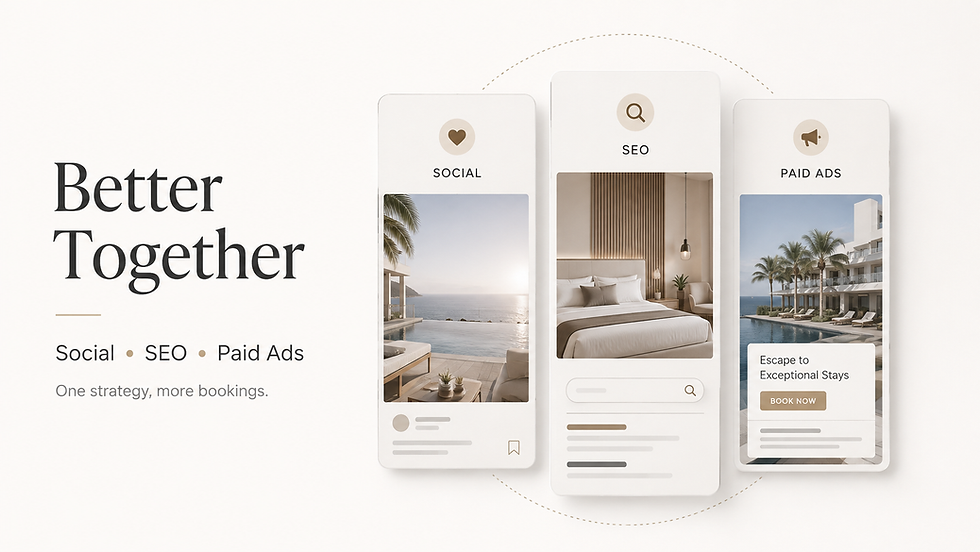
SEO, social media, and paid ads are not separate rooms in the hotel marketing estate. They are structural systems. Search creates visibility. Social creates belief. Paid media creates controlled momentum. When they work alone, each has limits. When they work together, they form a commercial machine that can attract, reassure, and convert guests with far greater consistency.
For resort developers and luxury hotel owners, the question is no longer whether each channel matters. The real question is how they interlock.
The broken puzzle in hotel marketing
Luxury guests rarely book after one touchpoint.
A family planning a festive-season resort stay may begin with Google. A couple comparing destination wedding venues may discover a property through a reel. A corporate decision-maker planning a leadership retreat may click a search ad, leave the website, return after seeing a testimonial, and book only after reviewing room categories and dining images.
The booking journey is layered. It is slow, emotional, and often shared between several people. A hotel’s digital presence must support that reality.
The broken puzzle appears when each channel tells a different story.
A few common fractures are easy to recognise:
The SEO content is strong, but the social feed looks inactive.
The paid ads are attractive, but they send users to a generic homepage.
The website has elegant copy, but the booking path feels slow or confusing.
Social media shows atmosphere, but there are no clear links to offers or packages.
Paid campaigns bring traffic, but there is no retargeting for guests who did not book.
Blog pages rank, but they do not guide readers towards suites, experiences, or enquiries.
Luxury marketing cannot afford these gaps. At a premium price point, guests are not only judging the room. They are judging the certainty of the promise.
The digital ecosystem must answer three questions in sequence:
Can I find this property when I am searching?
Do I believe the experience is as good as it claims?
Is there a clear reason to act now?
SEO, social media, and paid ads answer these questions together.
The three pillars of the hotel marketing machine
A strong hotel marketing system needs three pillars. Each one has a distinct function. None can fully replace the others.
SEO is the visible foundation
SEO gives a hotel discoverability at the moment of intent.
When a guest searches for “luxury resort near Jaipur”, “beach wedding venue in Kerala”, or “wellness retreat in Rishikesh”, they are not passively browsing. They are actively shaping a decision. Search places the property into that decision set.
For luxury hotels, SEO is not merely about ranking for broad phrases. It is about building a visible foundation across the full guest journey.
That includes pages for:
Destination-led searches
Room and suite categories
Wedding and event venues
Dining and spa experiences
Family holidays, honeymoons, retreats, and long stays
Local attractions and seasonal travel moments
Direct booking benefits
A resort that publishes a strong guide to “best time to visit Coorg for a luxury holiday” can attract guests before they have chosen a property. A hotel that builds a detailed page on “palace wedding venue in Udaipur” can meet high-value enquiries with purpose. A coastal resort with well-structured pages for villas, private dining, and water experiences gives search engines clear signals and gives guests clear pathways.
SEO also strengthens brand authority. A hotel that appears across several relevant searches begins to feel established before the guest has even visited the website.
Yet SEO has a limit. Search can bring the guest to the gate. It cannot, by itself, create the full emotional conviction needed for a premium booking.
That is where social media takes over.
Social media is the emotional proof
Luxury hospitality is sensory. Guests want to imagine the light in the suite at sunset, the texture of the breakfast setting, the stillness around the pool, the energy of the bar, the warmth of the arrival.
Social media gives that imagination a form.
A well-managed social presence proves the property is alive. It shows recent experiences, active guests, seasonal details, service rituals, and atmosphere. It translates architecture, cuisine, rituals, and views into emotional evidence.
For a luxury hotel, social media should not function as a notice board. It should behave like a moving portfolio.
The strongest social feeds show:
Real spaces with a sense of scale and light
Guest experiences without feeling staged
Food, wellness, design, and destination details
Weddings, celebrations, retreats, and intimate moments
Staff rituals that reveal care and service quality
Comments, saves, shares, and guest interaction
This matters because modern guests verify everything. After discovering a hotel on Google, many will check Instagram, YouTube, or Facebook before they book. They want to see whether the property matches the website. They look for recency. They read comments. They inspect tagged posts. They notice whether the tone feels premium or desperate.
A dormant social profile can quietly damage a strong SEO performance. It raises questions the website may not answer. Is the hotel still maintained at the same level? Are guests engaging with it? Does the experience feel current?
Social media builds trust through proof, but it also feeds the upper and middle parts of the booking journey. A guest may follow the property months before booking. They may save a reel for a future anniversary. They may share a wedding setup with a partner or family member.
Social is the emotional layer that keeps the property in mind until intent becomes action.
Paid ads are the accelerator
Paid ads give control.
SEO takes time. Social reach can rise and fall. Paid media allows the hotel to place the right message in front of the right audience at the right moment, especially when occupancy, seasonality, or revenue targets demand speed.
For luxury hotels, paid ads serve several roles:
Capture high-intent search demand
Promote seasonal offers and packages
Push wedding, MICE, wellness, or villa campaigns
Retarget website visitors who did not book
Reach lookalike audiences based on past guests or quality leads
Protect the brand name from third-party booking competitors
A paid search ad can appear when someone looks for “luxury resort in Alibaug with private pool”. A social ad can reintroduce a spa retreat to someone who visited the wellness page but left. A display or video campaign can build interest before a festive travel period.
The mistake is treating paid media as a tap. Turn it on, expect bookings. Turn it off, save money.
Paid ads work best when pointed at a strong destination. If the landing page is poor, the money leaks. If the offer is vague, the guest delays. If the social presence feels weak, trust falls. If the website is slow, paid traffic becomes expensive waste.
Paid ads accelerate the machine. They do not repair a weak machine.
The orchestra effect happens when the pillars move together
The most profitable hotel marketing does not ask each channel to perform alone. It asks them to support one another.
Imagine this sequence.
A luxury resort publishes a detailed SEO page about destination weddings on its property. The page ranks for relevant wedding venue searches. It includes clear details about settings, guest capacity ranges, culinary options, accommodation, photography locations, and enquiry paths.
At the same time, the resort’s social channels show recent wedding décor, mandap setups, couple portraits, guest brunches, and behind-the-scenes service rituals. Comments are active. Tagged posts reinforce the experience.
Then paid ads target engaged users, past website visitors, and people searching for comparable venues. The ads do not send them to the homepage. They send them back to the wedding page, or to a tailored enquiry page with the strongest proof.
The effect is not linear. It multiplies.
The guest has search intent, emotional proof, and timely prompting. They have seen the property in more than one context. They do not feel chased. They feel guided.
A high-ranking SEO page with active social proof behind it and paid traffic directed towards it has a far stronger chance of converting than any one channel alone.
This is the essence of How Social SEO and Paid Ads Work Together in Luxury Hotel Marketing. Search captures demand. Social reduces doubt. Paid media increases speed and frequency. The website holds the architecture together.
The same pattern applies to other high-value segments:
Segment | SEO role | Social role | Paid ads role |
Honeymoons | Rank for romantic stays and destination guides | Show privacy, dining, views, and rituals | Retarget couples with stay packages |
Villas | Capture searches for private pool villas or family stays | Prove scale, design, and comfort | Promote limited inventory in peak periods |
Wellness | Rank for retreat and spa-related searches | Show calm, treatments, cuisine, and setting | Reach interest-based audiences before holidays |
Events | Rank for conference, offsite, and retreat queries | Show spaces in use and service detail | Drive enquiries from decision-makers |
The orchestra effect requires consistency. The message, visual world, landing page, and offer must feel like parts of the same property.
If the ad promises solitude, the landing page must show privacy. If the SEO page speaks of heritage, social content must reveal craft and place. If social shows a premium villa, paid traffic should not arrive on a page where that villa is hard to find.
Luxury guests notice the seam.
The hotel marketing flywheel creates direct booking power
The most valuable digital systems do not depend on one campaign. They build momentum over time.
This is where the hotel marketing flywheel becomes useful.
A flywheel gains strength through repeated motion. Each turn supports the next. In hotel marketing, the motion can look like this:
Guest visits through SEO → Guest follows on social → Social ads retarget them → Guest returns to the website → Guest books direct → Guest shares content → New guests discover the property.
This cycle matters because direct bookings are not created only at the final click. They are built through accumulated trust.
Here is how the flywheel works in practice.
A potential guest searches for the best luxury stay near a hill station and lands on a destination guide. The guide feels useful, not pushy. It introduces the resort naturally through location, experience, design, and stay options.
The guest does not book that day. Instead, they visit the resort’s Instagram profile. The feed has current content, polished but human. They follow.
A week later, they see a reel of a private dining experience under the night sky. They save it. A few days after that, a retargeting ad presents a long-stay villa offer or a seasonal package. The ad returns them to a landing page with clear rates, inclusions, images, and booking access.
They book direct.
After the stay, they post a story, leave a review, or tag the property. That content becomes social proof for the next guest. Some of it supports future paid ads. Guest questions reveal new SEO content ideas. Search data reveals demand for new packages. Paid campaign data reveals which audiences respond fastest.
The wheel turns again.
The goal is not a one-time spike. The goal is a digital asset that compounds.
How to design the ecosystem with discipline
A hotel marketing ecosystem needs architectural thinking. Each layer must have a job, and each transition must be intentional.
Build the website as the central estate
The website is the owned asset. Social platforms can change their rules. Paid costs can rise. Search rankings can shift. The website must remain the central place where desire becomes revenue.
A strong hotel website should have:
Fast loading on mobile
Clear room and suite hierarchy
Strong visual storytelling
Direct booking prompts
Detailed experience pages
Simple enquiry forms
Trust signals such as reviews, awards, press mentions, and policies
Tracking that shows where quality traffic and bookings come from
Do not send all campaigns to the homepage. A guest interested in a wedding should land in the wedding world. A guest interested in a villa should land inside the villa story. A guest interested in wellness should not have to search through banquet content.
Make SEO pages useful enough to deserve attention
Luxury SEO content should not read like filler. It should help guests decide.
A good destination or experience page answers real questions:
When is the best time to visit?
Who is this stay best for?
What makes this location distinct?
What can guests do over two, three, or five days?
How does the property shape the experience?
What should guests know before booking?
Useful content earns time, links, shares, and trust.
Treat social content as proof, not decoration
Social media should support the claims made on the website.
If the website says “secluded”, show silence, space, and privacy. If it says “family-friendly”, show thoughtful details for children and multi-generational stays. If it says “culinary-led”, show the kitchen, the table, the ingredients, and the ritual of service.
The feed should feel current, coherent, and alive.
Use paid ads to connect the gaps
Paid media should identify where the guest has paused and bring them back with relevance.
Someone who visited a wedding page should not see a generic brand ad. Someone who viewed villas should see villa-led creative. Someone who searched for the property name should find the direct booking link before an online travel agency captures them.
The best paid campaigns are not loud. They are precise.
FAQ
How long does it take for SEO, social media, and paid ads to work together?
Paid ads can create traffic quickly, but SEO and social trust take longer to mature. A well-built system usually improves over months as content, data, retargeting audiences, and direct booking paths strengthen each other.
Should a luxury hotel invest in SEO or paid ads first?
The website and key SEO pages should be strong enough before heavy paid spend begins. Paid ads can then send traffic to pages that are ready to convert. If the site is weak, paid media often exposes the weakness faster.
Does social media really affect bookings?
Yes, often indirectly. Guests use social media to verify atmosphere, recency, service quality, and guest experience. A strong social presence can reduce doubt and make search or paid traffic more likely to convert.
What is the biggest mistake hotels make with paid ads?
They send every visitor to the same page. Campaigns should match intent. Wedding traffic needs wedding content. Villa traffic needs villa content. Wellness traffic needs wellness proof and a clear booking or enquiry path.
How can a hotel measure whether the ecosystem is working?
Track assisted conversions, direct bookings, returning visitors, enquiry quality, branded search volume, social engagement from target audiences, and landing page performance. The aim is to see whether channels support each other, not only whether each one wins the final click.
Build the machine, then accelerate it
Luxury hotel marketing works best when it is designed as a system.
SEO makes the property visible when intent appears. Social media makes the promise believable. Paid ads bring speed, control, and repetition. The website turns attention into direct revenue.
When one piece is weak, the guest feels hesitation. When the pieces connect, the journey feels natural. The property appears in search, proves itself through social presence, reappears through precise paid media, and welcomes the guest back to a booking path that feels considered.
That is the standard a premium property needs. Not more noise. A better-built machine.


Comments